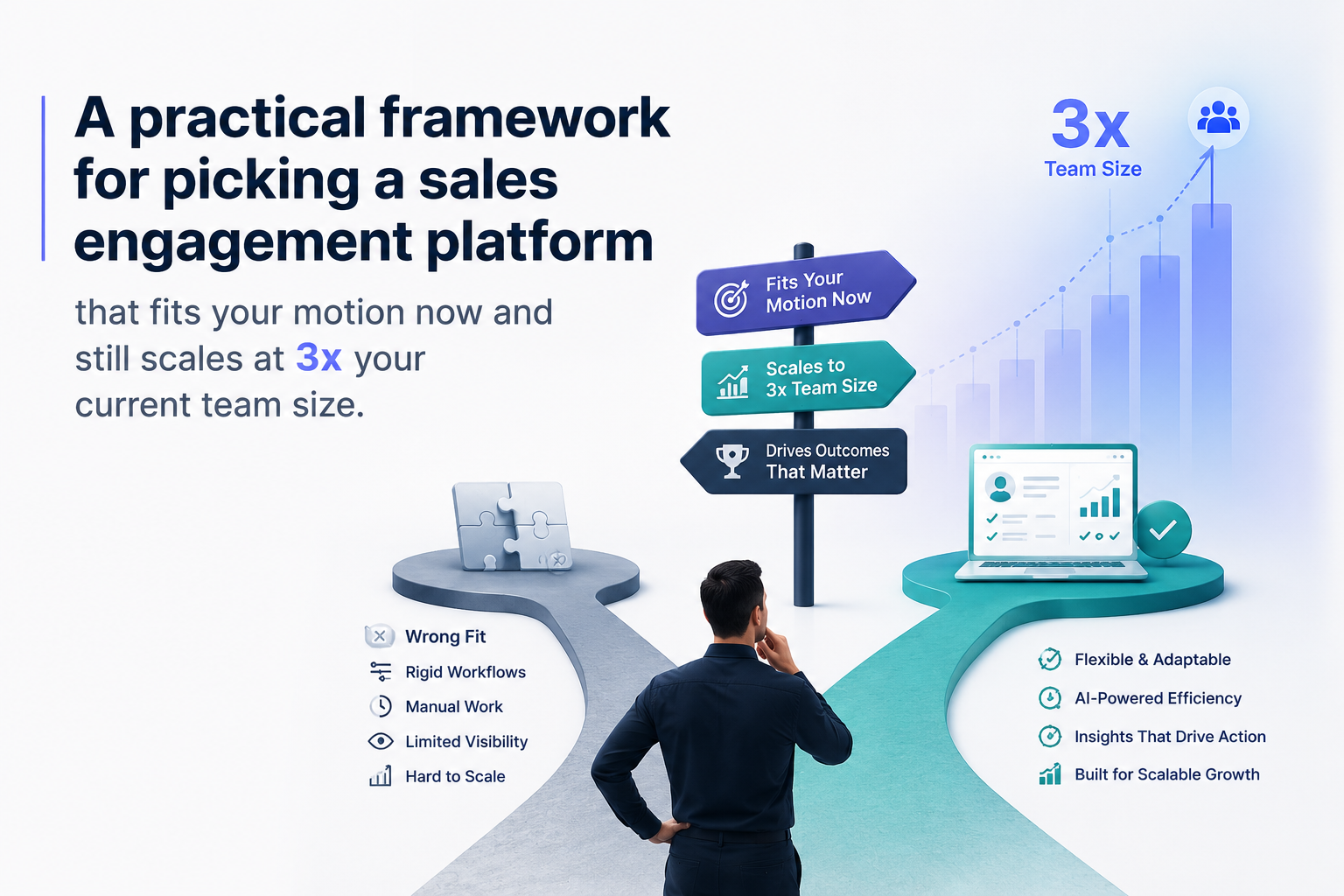
Somewhere between "we can manage outreach in spreadsheets and a shared inbox" and "we need a dedicated system," most growing sales teams hit a wall. Usually it happens around 5–10 reps: follow-ups start slipping, nobody's sure which sequence a prospect is actually in, and the CRM and the outreach tool tell two different stories about the same account. That's the point where a dedicated sales engagement platform stops being a nice-to-have and starts being infrastructure.
The hard part isn't deciding you need one — it's picking the right one before your team has outgrown a second tool in eighteen months. This isn't a top-10 vendor ranking. It's a framework for evaluating fit against your team's actual size, motion, and growth trajectory, so the decision holds up as headcount and pipeline both scale.
Signs you've actually outgrown your current setup
Before evaluating new platforms, it's worth confirming the problem is real rather than a temporary process gap that better discipline could fix. A few signals are fairly reliable indicators that the underlying issue is tooling, not process: reps genuinely can't tell which sequence a given prospect is in without checking multiple tabs across systems, managers can't get an accurate weekly view of activity without asking reps to manually compile it, and follow-up timing is inconsistent enough across the team that some prospects get five touches and others get one, purely based on which rep owns the account. If these problems persist after a genuine attempt to tighten process on the current setup, that's a strong signal the constraint is the tool, not the team.
It's worth distinguishing this from the opposite failure mode too — teams sometimes shop for a new platform because outreach results have plateaued, when the real issue is messaging, targeting, or an outdated ideal customer profile rather than the tool itself. A new platform won't fix a targeting problem, and it's worth ruling that out first so the evaluation effort goes toward solving the actual constraint.
Start with your sales motion, not the feature list
Feature comparisons make every platform look roughly interchangeable — they all claim multichannel sequences, CRM sync, and reporting. The real differentiator is which motion the platform was actually built around. A platform tuned for high-volume, short-cycle SMB outbound optimizes for sequence velocity and call volume. A platform built for longer enterprise cycles optimizes for multi-stakeholder tracking, account-based sequencing, and deal collaboration across a buying committee. Applying the wrong platform to your motion doesn't show up immediately — it shows up six months in, when reps are working around the tool instead of through it.
Before evaluating any vendor, get honest answers to three questions internally: What's the primary channel mix — email-heavy, call-heavy, or genuinely multichannel? Is the average deal a single-threaded, fast-cycle sale or a multi-stakeholder, longer-cycle one? And is growth coming from more reps doing the same motion, or from expanding into new segments that will need a different motion layered on top?
The CRM integration question is not optional
Every sales engagement platform claims CRM integration. The question that actually matters is depth: does the integration only push logged activities into the CRM, or does it pull CRM data back — deal stage, custom fields, ownership — to inform sequencing decisions in real time? A one-way sync creates exactly the kind of split-brain problem growing teams are usually trying to escape when they first invest in a platform.
Test this directly during evaluation rather than taking a vendor's word for it: change a deal stage in the CRM and see how quickly (and whether) the sales engagement platform reflects it. Add a custom field relevant to your ICP and confirm the platform can actually read and act on it, not just store it. A platform that's sales automation in name but shallow in CRM integration will require constant manual reconciliation exactly when your team is too busy growing to do it.
Scalability: what to check before you sign, not after
"Can it scale" is the most-cited criterion in buyer guides and the least specifically tested. Scalability isn't just "can we add more user seats" — it's whether the platform's core workflows still make sense at 3x your current headcount and 5x your current account volume. A few concrete checks matter more than the pitch deck's growth story:
| Check | Why it matters at scale |
|---|---|
| Per-seat vs. usage-based pricing model | Usage-based pricing can become unpredictable fast once volume grows; know the cost curve before committing |
| Onboarding time for a new rep | A platform that takes two weeks to onboard a new hire slows down every future hiring wave |
| Role-based permissions and territory structure | Flat, single-team setups often break down once you add managers, segments, or regions |
| Reporting depth beyond activity counts | Activity-volume dashboards stop being useful once leadership wants outcome-based reporting |
Where agentic capability changes the calculus
A growing but still lean team faces a specific version of the coverage problem: too few reps to give every target account genuine, personalized attention, and no budget yet to hire proportionally as the account list grows. This is exactly the gap that agentic execution is built to close — a platform that can monitor engagement and firmographic signals across the full account list, not just the accounts a rep has bandwidth to personally check, effectively extends a small team's coverage without adding headcount.
For a team evaluating platforms today, this is worth weighing more heavily than it might have been two years ago. A platform that's purely a sequencing and scheduling tool asks your reps to be the intelligence layer for every account, indefinitely. A platform with real AI SDR or sales intelligence capability built in shares that load, which matters more the faster your account list is expected to grow relative to headcount.
Onboarding and adoption: the criterion buyers underweight
The best platform on paper is worthless if reps route around it. Adoption friction shows up in three predictable places: an interface unfamiliar enough that reps default back to their inbox and a spreadsheet, a setup process that requires ongoing admin support just to keep sequences current, and reporting that managers don't trust enough to coach from. None of these show up in a feature comparison, but all three determine whether the platform actually changes behavior or just becomes one more login nobody uses consistently.
A practical test during evaluation: have one rep from each part of your process — an SDR doing volume outbound, an AE managing live deals, a manager who needs visibility — spend real time in the trial environment doing their actual job, not a scripted demo. Friction that shows up in that kind of test is friction that will show up at full rollout, just delayed and more expensive to fix.
Pricing structures and the cost curve as you grow
Per-seat pricing is predictable but can get expensive fast as headcount grows — worth modeling explicitly at 2x and 3x your current team size, not just at today's price point. Usage-based pricing (per contact enriched, per email sent, per call made) can look cheaper at small scale and become the more expensive option once volume climbs, especially for a team growing faster on activity than on headcount. Ask vendors directly for a projected cost at your expected 12-month and 24-month scale, not just current pricing — a platform that looks like the cheaper option today can become the more expensive one by the time you're evaluating renewal.
Also worth asking explicitly: what features are gated behind higher tiers, and are any of those features ones your team will need once you scale past your current segment (e.g., account-based sequencing, advanced reporting, or role-based permissions)? Vendors are generally upfront about this if asked directly, but it rarely shows up unprompted in a sales conversation.
Multichannel support: matching channels to how your buyers actually respond
Almost every platform now claims multichannel support — email, calls, LinkedIn, sometimes SMS. The distinction that matters for a growing team is whether channels are genuinely coordinated in one sequence (a prospect who doesn't open an email gets a LinkedIn touch automatically, without a rep manually switching tools) or whether "multichannel" just means three separate features bolted together that a rep has to manage independently. The second version adds administrative overhead without actually solving the coordination problem a single dedicated platform is supposed to solve in the first place.
It's worth mapping this against your own buyer behavior rather than assuming more channels is automatically better. A team selling into technical buyers who live in Slack and rarely answer cold calls gets little value from a platform's power-dialer features, no matter how polished; a team selling into operations leaders who respond well to phone outreach needs strong calling infrastructure more than a fifth social channel. Matching the platform's channel strengths to where your buyers actually respond is a better filter than counting how many channels a vendor lists on their pricing page.
Data quality and enrichment: a quieter but critical factor
A sales engagement platform is only as good as the contact and account data flowing into it. Teams evaluating platforms often focus entirely on sequencing and reporting features while treating data enrichment as an afterthought, then discover months in that stale or incomplete contact data is undermining personalization and deliverability regardless of how good the sequencing logic is. This connects directly back to lead enrichment — a platform with weak or no native enrichment will require a separate tool and a manual data-passing process, which reintroduces exactly the kind of split-brain friction between systems that picking a dedicated platform was supposed to eliminate.
When evaluating this, ask specifically how the platform handles decayed data — job changes, company moves, role updates — since B2B contact data degrades continuously and a platform with no update mechanism will slowly accumulate the same kind of stale-record problem a spreadsheet-based process has, just inside a nicer interface.
A practical evaluation checklist
Support and implementation: what happens after the contract is signed
Growing teams often evaluate the product heavily and the vendor relationship lightly, then find out during onboarding that support quality and implementation speed matter just as much as the feature set. A platform with a strong product but a slow, ticket-based support model can leave a growing team stuck mid-rollout at exactly the moment momentum matters most. Ask vendors directly during evaluation what onboarding actually looks like week by week, who owns implementation on their side, and what support response times look like at your tier — not the enterprise tier the sales rep is describing in the pitch.
It's also worth asking existing customers of a similar size directly, rather than relying only on case studies the vendor selected. A five-minute call with a company that adopted the platform at a similar stage of growth will surface onboarding friction and support gaps far faster than a polished reference case study will.
What growing teams tend to get wrong
The most common mistake isn't picking a bad platform — it's picking a platform sized for today's team without pressure-testing whether it holds up at the size the team is planning to become. A tool that's perfect for 5 reps selling one motion can become a genuine liability at 25 reps across two segments, and migrating off a platform a team has built two years of process around is a much bigger project than choosing carefully the first time. The second common mistake is under-involving the reps who'll actually use the tool daily in the evaluation, then being surprised when adoption lags after rollout — the people doing the real-workflow trial in step 4 above should be the same people who'll be living in the tool a year from now, not just sales leadership evaluating a slide deck.
Choosing a sales engagement platform for a growing team is less about finding the tool with the most features and more about finding the one whose defaults match how your team actually sells — and whose ceiling is high enough that the choice still looks right at double or triple your current size.