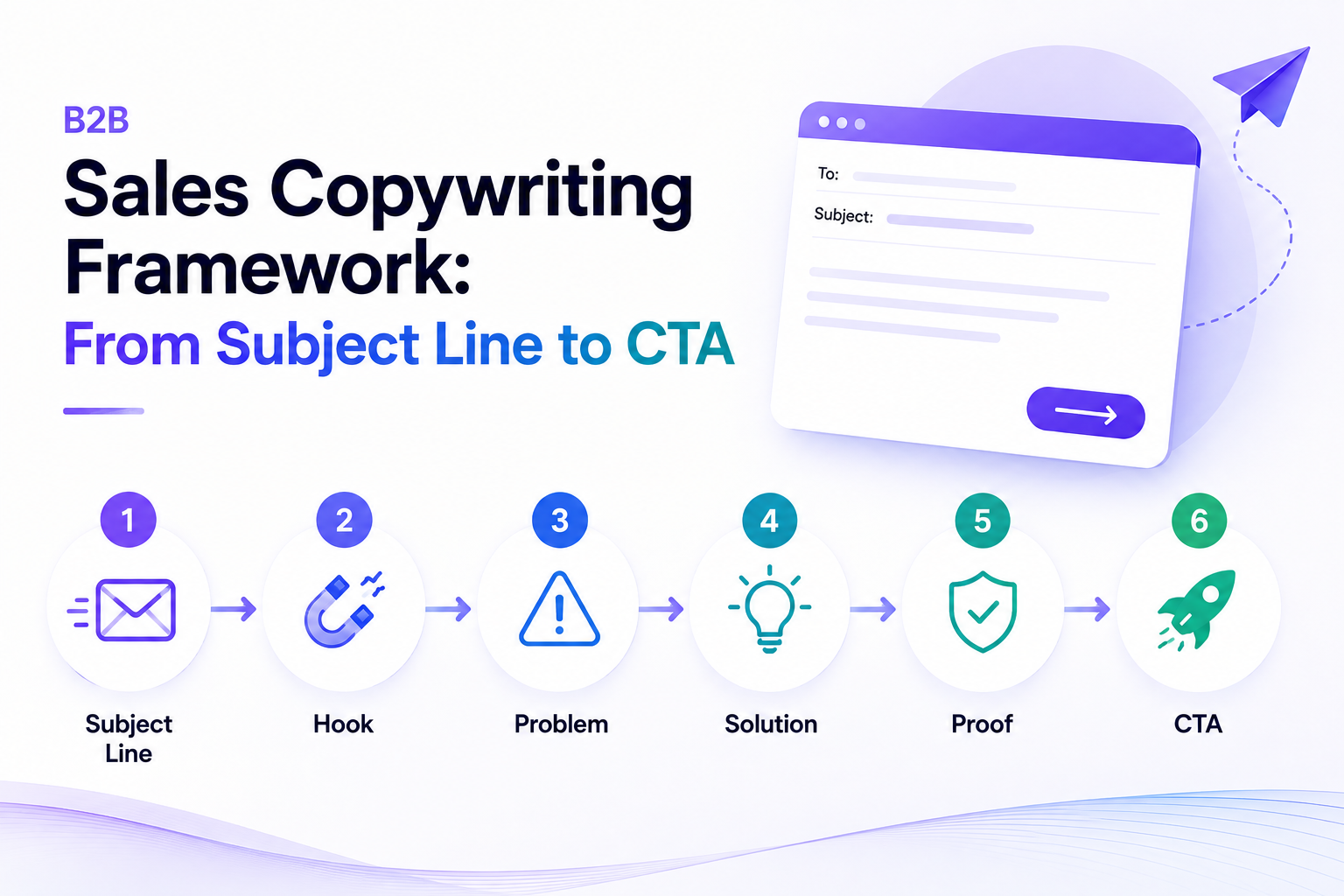
Most B2B cold emails fail before the body copy ever gets read. Roughly 70% of recipients decide an email is spam based on the subject line alone, and the average B2B buyer now sees 60-120 cold emails a week — up from single digits less than a decade ago. Writing good sales copy in 2026 isn't optional polish; it's the difference between a message that gets a chance and one that never gets opened at all.
This is a practical framework for the full arc of a B2B sales email — subject line, opening line, body, and CTA — built around what current data actually shows moves open and reply rates, not general copywriting folklore.
Subject lines: the two-second decision
A subject line has roughly two to three seconds and about 40 characters of mobile screen space to earn an open. Everything about writing one well flows from that constraint. The current data points in a consistent direction on a few specific variables worth testing in order of impact.
Worth noting explicitly: "Quick question," the single most commonly reused subject line in cold outreach, actually underperforms the average — one large-scale analysis of 31 million emails found it returning a below-average open rate compared to alternatives. Reaching for the most familiar line in the genre is often reaching for one of the weaker options in the data.
What to avoid in a subject line
The spam-trigger list hasn't changed much, but it's worth restating because AI-generated outreach has made violating it easier than ever: avoid "free," "guarantee," "urgent," "act now," and similar promotional language, and avoid fake "RE:" or "FWD:" prefixes on a first-touch email with no prior thread — both patterns are specifically flagged in recent deliverability research as damaging beyond just looking spammy; they can trigger actual spam filters. Personalizing a subject line with a first name specifically has been shown in some 2026 research to underperform non-personalized lines in certain contexts, which runs counter to older conventional wisdom — worth testing on your own list rather than assuming it always helps.
The opening line: earning the next sentence
Once a subject line earns the open, the first line of the body has to earn the next one. The most common failure here is starting with the sender rather than the recipient — "My name is X and I work at Y" wastes the highest-attention real estate in the email on information the prospect doesn't yet care about. A stronger opening leads with something specific to the recipient's situation: a trigger event, a role-specific pain point, or a direct reference to something current about their company.
This is where lead enrichment data earns its value in the copywriting process itself, not just in targeting — a genuinely personalized opening line requires knowing something real and current about the prospect, not just their name and title. Generic personalization (inserting a first name into a template) doesn't produce the kind of specificity that current data shows actually moves reply rates.
Body copy: length, structure, and tone
Current benchmarks converge on a specific range: 50-125 words tends to produce the highest reply rates, with first-touch emails performing best under 80 words carrying a single CTA. This is meaningfully shorter than what many reps still default to, and the direction of the data is consistent — brevity outperforms comprehensiveness in a first cold touch, where the entire goal is earning a reply, not closing the deal in one message.
Tone matters as much as length. Research on B2B email performance consistently favors a conversational register — writing like one colleague reaching out to another with a useful suggestion — over either stiff formality ("Dear Sir or Madam") or hype-driven language ("revolutionary, once-in-a-lifetime opportunity"). Both extremes read as inauthentic in a B2B inbox that's grown skeptical of anything that sounds like a template.
| Element | Data-backed guidance |
|---|---|
| Word count (first touch) | Under 80 words, single CTA |
| Links | One maximum — additional links can reduce reply rate and raise deliverability risk |
| Questions in body | Test question-free, action-based framing — one analysis found no-question emails earned an 11% higher reply rate |
| Send timing | Tuesday-Thursday, 9-11 AM prospect local time; avoid Monday and Friday for first touch |
The CTA: right-sizing the ask
The most consistent finding across CTA research is that B2B outreach systematically over-asks in early touches. A first cold email that requests a full demo or a 60-minute call is asking for a level of commitment the relationship hasn't earned yet. The better-performing approach treats early CTAs as "micro-commitments" — a quick yes/no, a short qualifying question, or permission to send something useful — and reserves firmer asks (a scheduled call, a specific meeting time) for later touches once some engagement already exists.
Specific, low-friction CTAs have been shown to lift conversion 2-3x compared with vague or oversized asks in some tested campaigns. A CTA like "Would you be open to a brief 10-minute call to see if this is a fit?" is measurably easier to say yes to than "Let's schedule a demo," even though both are technically asking for the same category of next step.
A single CTA per email, always
One of the more strongly evidenced findings in this area: emails with a single, clear CTA see dramatically more engagement than emails offering multiple possible next steps — one study found 371% more clicks on single-CTA emails compared to multi-CTA versions. This runs against a common instinct to give the prospect "options" (reply, click this link, or book a call) — in practice, offering three paths to choose from produces decision paralysis rather than more conversions. Pick the single best next step for the touch and ask for only that.
Putting the framework together
A complete first-touch email built on this framework has a distinctive shape: a short (2-6 word), specific subject line, an opening line that references something real about the recipient rather than the sender, a body under 80 words that states a clear, credible reason for reaching out, and a single, small CTA that's easy to say yes to. None of these elements work in isolation — a great subject line with a generic, over-long body still underperforms, and a tight, well-personalized body with an oversized CTA still stalls at the finish line.
Where this connects to broader outbound strategy
Good copy amplifies good targeting — it doesn't replace it. The most beautifully written email still underperforms if it's reaching the wrong ideal customer profile, and a strong subject-line-to-CTA framework applied across a poorly targeted list will still produce weak reply rates. This is also where sales intelligence earns its place in the copywriting process — the specific, current details that make an opening line land (a funding announcement, a leadership change, a tech stack signal) come from the same data layer that informs targeting, not from generic personalization fields.
Teams running outbound sales at scale increasingly rely on an AI SDR layer specifically to apply this kind of framework consistently across hundreds of emails a week — the principles here are simple to state but genuinely time-consuming to execute by hand at volume, which is part of why so much cold email still defaults to generic templates despite the data clearly showing personalized, tightly-scoped copy performs better.
How subject lines and CTAs should differ by use case
Not every subject line is solving the same problem, and grading a re-engagement line against a first-touch prospecting benchmark produces misleading conclusions. A first-touch prospecting subject line has to earn attention from someone who's never heard of you — specificity and a hint of relevance carry the most weight there. A follow-up subject line, sent to someone who's already seen your name once, can afford to reference the earlier email directly or add a new angle, since the cold-open problem has already been partially solved. A re-engagement line, sent to a long-silent thread, does best when it's honest about the gap rather than pretending the silence didn't happen — a line acknowledging "haven't heard back" tends to outperform one that repeats the original pitch as if nothing had changed.
The same logic applies to CTAs across this same arc. A first-touch CTA should be the smallest possible ask. A follow-up CTA can be slightly firmer if the first touch showed any engagement signal — an open, a click, a partial reply. A re-engagement CTA often performs best as an explicit "should I stop reaching out" framing, sometimes called a breakup email, which paradoxically tends to produce replies from prospects who were interested but hadn't prioritized responding.
Common mistakes that undercut good copy
A few patterns show up repeatedly in underperforming B2B email copy, even when individual elements look reasonable in isolation. The first is a mismatch between subject line and body — a curiosity-driven subject line that opens a door the body then fails to walk through kills not just that email's reply rate but the credibility of the next email in the sequence, since the prospect now associates your name with a bait-and-switch pattern. The second is stacking multiple asks into one email — a CTA to reply, plus a link to click, plus an invitation to a webinar — which research consistently shows underperforms a single, focused ask, even though it intuitively feels like offering more options should help.
The third, and probably most common in 2026 specifically, is over-relying on AI-generated personalization that technically references something true about the prospect (their company name, their industry) without saying anything specific enough to demonstrate real research. "I noticed you work in SaaS" is technically personalized and functionally generic — it doesn't clear the bar that current data shows moves reply rates, because it could apply to thousands of other recipients equally well.
Testing the framework on your own list
Every guideline above is a strong prior from aggregate data, not a guarantee for any specific audience or industry. The right way to apply this framework is as a starting hypothesis to test against your own list — running structured A/B tests on one variable at a time (subject line length, CTA size, question versus statement framing) with enough volume per variant to draw a real conclusion, generally 300-500 recipients per variant held for at least 48-72 hours across normal business days. Teams that skip testing and simply copy best-practice guidance verbatim often see smaller gains than teams that use the guidance as a testing roadmap specific to their own audience and vertical.
Good B2B sales copy in 2026 isn't about clever tricks — it's about respecting how little attention a cold email actually gets and building every element, from the subject line to the CTA, around earning the next small action rather than trying to win the whole deal in one message.